
What Drives Most Businesses to Start an Automation Project
Most of the time conversations about automation start in the way. A plant manager is walking around the floor. Sees someone adjusting a motor speed by hand or flipping a switch to start a pump. The manager thinks, “there must be a way to do this”. Usually there is. The question is not whether or not to use automation. The question is, which products really work like they are supposed to when they are installed and running in situations.
This is when businesses start calling an Automation Product Supplier in UAE. The difference between what automation’s supposed to do and what it actually does often comes down to the equipment that is chosen and who picks it. At Pokhara Motors every conversation about automation starts with what the process needs not what is easy to sell.
Over the region businesses call Pokhara Motors because they are looking for an Automation Product Supplier in Saudi Arabia, Qatar or Oman. They call for a few reasons. Maybe their current system is too manual and too slow. Maybe they are setting up a facility and they need motor control built in from the beginning. Maybe they have an old panel that needs to be replaced before it breaks down and stops production, which would be a big problem.
What Industrial Automation Actually Controls
The term “automation” is quite broad. It would be good to define how it actually functions in industry.
Simply put, industrial automation is making sure that machines can start, stop, regulate, and react to external factors on their own. This means, for example, that a machine will slow down automatically when the speed of the assembly line changes. The pump will turn on if the pressure in the tank is below a certain level. The conveyor belt will stop immediately if there is some kind of blockage detected by sensors. All this is made possible with the help of automation equipment, which includes drives and control panels placed between the power source and the machine itself.
If automation is done correctly, then the plant will work more steadily, will consume less energy, and will need far fewer operators who watch gauges and control them manually. If not, you will get an automated system which malfunctions all the time, needs manual intervention to work, and cannot properly interact with other units of the assembly line.
The Two Jobs Automation Equipment Has to Do Simultaneously
In fact, any device of industrial automation has two basic functions. But to perform the whole task, both functions must be performed correctly.
Firstly, there is the function of control. This means giving the right instructions to the motor or machine – when and how fast it should operate, etc. Secondly, there is a protective function that means ensuring that in case of failure of other units, the system will react properly and not become part of the trouble itself. In this category fall overcurrent protection, voltage trips, overload relays and others.
Most often, failures of automation systems are not the failures of the equipment itself, but the failures of the integration of the equipment. Thus, the Automation Product Supplier in UAE who can integrate the systems properly is definitely more valuable than those who just sells the product out of the catalogue. Same approach is required while searching for an Automation Product Supplier in Saudi Arabia for the large processing facility.
Industries Running on Automation Products Daily
The range of industries that use industrial automation products in this area exceeds the expectations of most people:
- Oil and gas: automated pump control, motor management and process safety panels
- Manufacturing: conveyor management, injection molding lines and production automation
- Water treatment and desalination: pump stations, dosing systems and remote monitoring
- HVAC and building management: automated fan speed, chiller control and ventilation management
- Construction: automated material handling and concrete mixing systems
- Food and beverage processing: conveyor control, mixing automation and bottling lines
- Textile manufacturing: speed control for spinning and weaving machinery
Each industry utilizes the same basic components of the industrial automation – drives and control panels, but their configurations, the degree of protection and type of communications vary greatly depending on what area they are used in. Water treatment plant which calls an Automation Product Supplier in Qatar will have completely different requirements than Textile Mill which calls Automation Product Supplier in Oman, even though both will get a VFD and Control Panel in the end.
Why the Supplier Relationship Matters More Than the Product Specification
The VFD specification is uniform whether the drive works flawlessly or trips out every third day. It does not say whether the communication protocol used by the drive works with the already existing PLC whether the cabinet to which the drive is mounted was made to fit the ambient temperature that will be reached in the installation. Such things are not mentioned in the specifications.
This is what distinguishes a good Automation Product Supplier in Saudi Arabia from one who simply performs the orders. Pokhara Motors considers any automation order as a problem of configuration, not as a commercial operation. This approach implies collecting data about the existing system, environment, communication setup, and load profile.
What the Right Automation Setup Actually Fixes
For an establishment that has been operating manually for too long, a well-configured system of automation has many impacts all at once:
- Attention of the operator changes from watching to managing.
- There is a decrease in energy consumption as motors and pumps do not run at top speed, despite their real requirements.
- The life of equipment is increased due to motors’ soft starting and load matching rather than abrupt turning on.
- There is an increase in fault detection through automatic shut-downs and alarm systems rather than the discovery of faults when there is already a problem.
- There is remote monitoring so the presence of an individual at all panels is reduced.
None of this is accomplished by merely purchasing automated equipment. It comes from configuring this equipment in the right way to the process. This is the bit that most companies underestimate at first mention.
Common Integration Mistakes That Cost Facilities Later
Mistakes that will do the greatest damage in automation projects are not those that are easily recognizable. These are mistakes that become evident a few weeks after the installation of the equipment:
- Communication mismatch between the VFD and the existing PLC only realized by the commissioning engineer upon installation.
- Control panels rated for normal operating conditions but installed in dirty outdoor locations, hence early failure of relays.
- Drive oversized for the load by matching it to the motor nameplate while peak loads exceed the motor nameplate.
- Design of the panels such that future maintenance will be difficult owing to no consideration of the same during installation.
- No provision of any surge protection in areas that have frequent variations in power supply conditions.
Any Automation Product Supplier in Qatar who has been around for a while will be able to detect such things before they occur, at the specification phase, and not once the equipment is installed and problems begin surfacing. This holds true for any Automation Product Supplier in Oman where equipment installation takes place at remote sites.
How Regional Conditions Shape Automation Equipment Choices
Operating in countries like UAE, Saudi Arabia, Qatar and Oman is working in an environment that tests automation equipment more than anywhere else in the world:
- High ambient temperatures that impact thermal ratings of drives and cooling requirements of the panel
- Dust and sand penetration into anything that is not totally enclosed
- Fluctuations in humidity levels in particular at sites along the coast
- Fluctuating power supplies that drives and panels must withstand without nuisance trips
- Sites where remote installation means infrequent access for servicing
The performance of a control panel or VFD in laboratory settings does not necessarily mirror its behavior when operating in an environment where the temperature reaches 45°C and is dusty. That’s why business organizations need to choose an Automation Product Supplier in UAE, Saudi Arabia, Qatar, or Oman that has practical experience in the region rather than just importing generic products. This is the philosophy of Pokhara Motors.
Keeping Automation Equipment Running Over the Long Term
Automation machinery is dependable based on the maintenance provided for it. Some practices that really make a difference are:
- Maintaining the panel interior dust-free and examining gaskets and seals regularly to ensure IP ratings
- Checking drive operating temperatures and testing cooling fans’ functionality at regular intervals
- Testing communication systems and PLC inputs regularly rather than relying on them until a failure occurs
- Examining parameter values after changes in load or process have been made since the default values set by manufacturers do not always remain appropriate
- Recording panel wiring and configurations to avoid having to rely on reverse engineering when performing maintenance
Those facilities that integrate such practices into their routine operations achieve much better performance from their automation machinery.
What Pokhara Motors Offers
Veichi VFD
Veichi VFD is Pokhara Motors’ variable frequency drive solution for industrial motor control, covering a power range of 0.5 to 250 kW across single phase to three phase and three phase applications.
Key Details:
- Power Range: 0.5 – 250 kW
- Input Voltage: 220–240V Single-phase / 380–480V Three-phase
- Control Type: V/F Control, Vector Control
- Communication: Modbus, CANopen, Profibus (depending on model)
- Operating Temperature: –10°C to +50°C
- Duty: Continuous (S1)
- Mounting: Wall-mounted or Panel-mounted
- Protection: Overload, Overvoltage, Undervoltage, Short-circuit
Applications: Pumps, fans, compressors, conveyors, CNC machinery, injection molding, extruders, cranes, hoists, elevators, mixers, textile machinery, water treatment, crushers, HVAC systems, irrigation, packaging machines, and printing machines.
Pokhara Control Panel
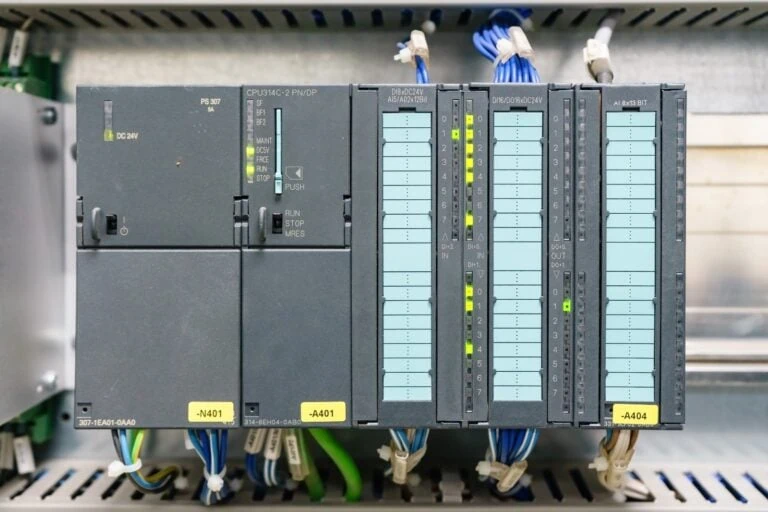
Pokhara Control Panel is Pokhara Motors’ customizable industrial control solution, available in safe-area and Ex-proof configurations to suit both standard and hazardous environments.
Key Details:
- Voltage Rating: 220–415V AC
- Power Rating: Up to 250 kW (depending on configuration)
- Enclosure Material: Mild Steel / Stainless Steel
- Protection Rating: IP54 / IP65
- Control Type: Manual / Automatic / PLC-controlled
- Features: PLC integration, HMI, Remote Control, LED indicators, push buttons, alarms
- Mounting: Wall-mounted / Floor-mounted
- Operating Temperature: –10°C to +50°C
- Duty: Continuous (S1)
- Configuration: Standard or fully customized
Applications: Industrial automation, motor control, pump and HVAC systems, conveyor systems, and custom machine operation.
As a trusted Automation Product Supplier in UAE, Saudi Arabia, Qatar, and Oman, Pokhara Motors helps businesses move from manual, reactive equipment management to something controlled, monitored, and matched to the actual process. Having the right drive and control panel combination makes the difference between automation that performs and automation that just adds complexity.
The Difference the Right Supplier Makes Over Time
Industrial automation isn’t a single product purchase. It’s a configuration decision that affects how a facility runs for years. Getting the VFD, control panel, and integration details right from the start saves a lot of expensive corrections later. It starts with working with a supplier who asks the right questions before quoting anything.
Contact Pokhara Motors
For reliable automation product solutions and expert support as your trusted Automation Product Supplier in UAE, Saudi Arabia, Qatar, and Oman, contact Pokhara Motors:
UAE (Head Office)
📞 +971 6 566 8176 | +971 6 566 8076
📧 sales@pokharamotors.com
Saudi Arabia
📞 +966 53 965 4113 (Dammam) | +966 53 038 0546 (Jeddah)
📧 ksa@pokharamotors.com
Qatar
📞 +974 6616 3852
📧 salesqa@pokharamotors.com
Oman
📞 +968 7949 7973
📧 oman@pokharamotors.com
🌐 Website: https://pokharamotors.com/